
Megalodon: Why OIDC Alone Won't Save You

Originally written in French by
Stéphane Robert
DevSecOps Architect | Plumber Ambassador
Republished in English with permission.
Read on blog.stephane-robert.infoFor two years now, I have been repeating the same sentence to the teams I work with: “switch to OIDC, remove your AWS_ACCESS_KEY_ID from your GitHub secrets.” That has stayed true. But after the May 2026 attacks (actions-cool/issues-helper, then Megalodon and its 5,561 booby-trapped repositories), I no longer phrase the advice the same way.
The problem is not OIDC. The problem is that OIDC has become an end point in the security conversation, when it should be a starting point. The two May attacks don’t use exactly the same technique, but they exploit the same forgotten boundary: the CI/CD runner.
With actions-cool/issues-helper, the attacker hijacks action tags and triggers the execution of an imposter commit capable of reading the memory of the Runner.Worker process. With Megalodon, the attacker directly injects malicious GitHub Actions workflows into public repositories and collects environment variables, credential files, kubeconfigs, SSH keys, and OIDC tokens.
In both cases, the lesson is the same: OIDC removes static cloud credentials, but it does not neutralize the code that runs inside a job authorized to handle temporary credentials. This post is a correction to my own advice. I am not backing off from recommending OIDC; I am clarifying what needs to be stacked around it so the argument holds up in 2026.
What OIDC actually solves
The classic scenario fits in one line: an AWS_ACCESS_KEY_ID + AWS_SECRET_ACCESS_KEY secret stored in GitHub Secrets, valid for months, copied by hand from one teammate to another, forgotten in a fork, exfiltrated the day a third-party workflow runs with too many privileges.
OIDC breaks this pattern. GitHub signs a JWT describing the identity of the job (repo, ref, workflow, job, environment). The target cloud verifies that signature, applies its trust policy, and returns temporary credentials valid for 15 minutes to 1 hour. No more long-lived credentials to protect on the GitHub side.
This is exactly what I document in the guide OIDC GitHub Actions: secretless authentication and its cloud counterpart OIDC AWS, Azure, GCP. The implementation is simple, the improvement in posture is real, and I am not walking back that recommendation.
What OIDC does not solve
The temporary credential obtained through OIDC is not a secret stored durably in GitHub, but it does become exploitable data while the job is running: an environment variable (AWS_ACCESS_KEY_ID, AWS_SESSION_TOKEN exported by default by aws-actions/configure-aws-credentials), a credentials file, a token requested by a step, or an artifact reachable from the runner context depending on the action used.
Any code that runs during that window in the same runner sees this credential. A malicious third-party action, an injected workflow, a post-install script of an npm dependency, a read of /proc/<PID>/environ or /proc/<PID>/mem: all of them can extract this sensitive data.
This is exactly Megalodon’s modus operandi: direct injection of a malicious workflow that collects the runner’s environment variables, credential files, kubeconfigs, and the OIDC tokens requested from the job. A cloud token valid for 15 minutes is enough for an industrial-scale attacker. They have the tooling to exfiltrate it and reuse it within the validity window.
So the illusion to correct is simple: “OIDC = no stealable credentials” is false. OIDC removes persistent credentials. It does not remove ephemeral credentials. Both families are stealable, but with very different risk windows.
The scenario I didn’t see coming
Picture a clean deploy.yml workflow, like dozens I have written. Default permissions read-only. id-token: write set only on the deployment job. An AWS trust policy that requires repo:my-org/my-repo:ref:refs/heads/main. The aws-actions/configure-aws-credentials action pinned by SHA. On paper, this is what you’d call a hardened workflow.
jobs: deploy: runs-on: ubuntu-latest permissions: id-token: write contents: read steps: - uses: actions/checkout@<SHA> - uses: aws-actions/configure-aws-credentials@<SHA> with: role-to-assume: arn:aws:iam::123456789012:role/deploy aws-region: eu-west-3 - run: ./scripts/deploy.shThe problem doesn’t show up as long as no foreign step is inserted. The day an attacker injects a step before or after configure-aws-credentials (through a malicious commit on .github/workflows/, a third-party action compromised by tag, or a dependency that runs during ./scripts/deploy.sh), they get either the GitHub JWT (before the exchange) or the temporary AWS credentials (after the exchange).
In either case, the attacker has a 15- to 60-minute window to assume the deploy role from their own infrastructure. That is more than enough to automate exfiltration or plant a cloud backdoor.
The four layers to stack around OIDC
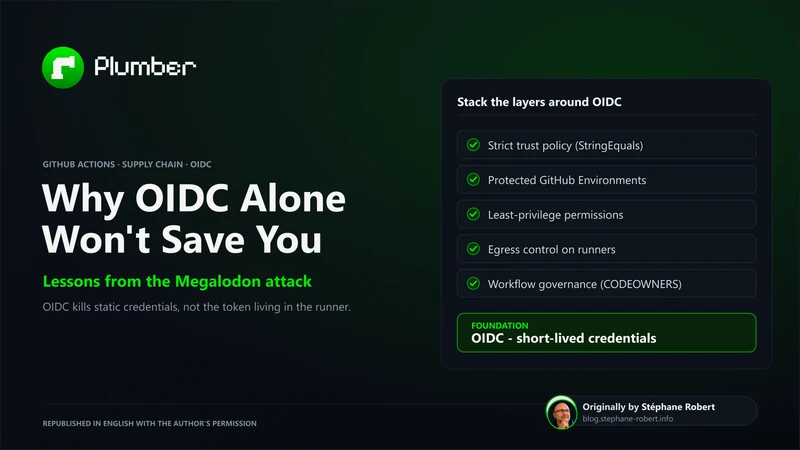
OIDC is necessary but not sufficient. Here are the four layers I now consider mandatory in any GitHub Actions architecture that touches production.
A strict cloud trust policy. The JWT’s sub condition must be constrained as much as possible: precise repo, precise branch, or precise environment. Avoid broad StringLike patterns and organization-wide wildcards; prefer StringEquals on a precise sub when you can. This is the first barrier, and it is the one that prevents a forked workflow or a test branch from assuming the production role.
Minimal GitHub permissions. id-token: write set only on the job that needs it, never at the workflow level. contents: read by default. See the guide GitHub Actions GITHUB_TOKEN permissions for the details.
Egress control on the runner. This is the most forgotten layer. If a malicious payload cannot reach the attacker’s infrastructure, credential exfiltration fails. Harden-Runner in block mode or a firewall allow-list on a self-hosted runner do exactly this job. I cover the patterns in Hardening the build environment.
Strong workflow governance. The .github/workflows/ directory must be treated as production code: CODEOWNERS enforcing a review by the security team, SHA pinning of third-party actions, strict branch protection. This is precisely the lesson of the attack on actions-cool/issues-helper, which preceded Megalodon by a few hours.
None of these layers replaces the others. And none removes the need for OIDC. They stack.
Hardening an AWS trust policy after Megalodon
This is the mistake I see most often during audits: an AWS trust policy written to “work everywhere in the organization,” and therefore too broad to withstand a targeted attack.
The pattern to avoid:
{ "Condition": { "StringLike": { "token.actions.githubusercontent.com:sub": "repo:my-org/*" } }}The StringLike with a wildcard allows any repo in the organization to assume the role. Any branch, any workflow, any environment. The day a secondary repo in the organization is compromised, the attacker assumes the production role without forcing anything.
The pattern to aim for:
{ "Condition": { "StringEquals": { "token.actions.githubusercontent.com:aud": "sts.amazonaws.com", "token.actions.githubusercontent.com:sub": "repo:my-org/my-repo:environment:production" } }}StringEquals instead of StringLike. Sub limited to a precise repo and a precise environment, not a branch, because an attacker who pushes a commit to main remains legitimate, whereas an attacker who requests the assumption from the production environment must first pass that environment’s approval gate. It is the chaining that hardens, not each link in isolation.
StringLike is not forbidden in itself. GitHub’s own documentation shows wildcard examples to allow several branches or environments of the same repo. The problem is the overly broad wildcard (repo:my-org/*). If StringLike is necessary, restrict it to a strict, documented, and tested pattern.
The exact format of the sub claim depends on the trigger (branch, tag, environment, pull request). Check the documentation before pasting an example into your trust policy. A malformed sub blocks the deployment without a clear message.
The GitHub environments trap
GitHub Environments remain underused. That’s a shame, because they add exactly the piece that’s missing in an OIDC workflow: a human gate before the token exchange.
A production environment can require:
- required reviewers (mandatory human approval before the job starts);
- a wait timer (a forced delay before execution);
- allowed branches (only
maincan deploy toproduction); - secrets scoped to the environment, invisible to other jobs.
Coupled with an AWS trust policy that requires environment:production in the sub claim, this gives a coherent defensive chain: no deployment without human approval, and no valid OIDC token without a validated environment. A protected environment would not have made Megalodon impossible, but it would have changed the dynamic. The injected workflow could no longer silently obtain a production token without going through an approval rule, a branch restriction, or a visible deployment control.
This is the layer I forgot the most in my recommendations. I don’t forget it anymore.
What I changed in my advice
Before May 2026, I said: “switch to OIDC.” Full stop, as if the absence of a static credential settled the matter.
Today, I say: “switch to OIDC, AND enforce a protected environment, AND scope the trust policy to a precise sub, AND cut off the runner’s egress, AND protect .github/workflows/ with CODEOWNERS.” Five requirements instead of one.
It’s heavier to state. It’s also more honest. OIDC remains the right foundation. But a foundation alone is not a house, and an attack like Megalodon is a reminder that an industrial-scale attacker does not stop at the most visible wall. They look for the open window.
Common mistakes I see during audits
Four patterns come up in almost every GitHub Actions audit:
id-token: writeat the workflow level instead of the job. All the workflow’s jobs can then request an OIDC token, even the ones that don’t need it. This is the first thing to fix.- A
StringLiketrust policyrepo:my-org/*. To be replaced withStringEqualson a precise sub, ideally with an environment. - No protected environment on the deployment job. Without a human gate, any commit that passes CI deploys to production with the cloud credentials.
- No egress control on the runners, neither
Harden-Runnernor a firewall allow-list. A payload that steals the credentials can exfiltrate them without any network constraint.
None of these mistakes is dramatic in isolation. The four together form exactly the playground that Megalodon-family attacks are waiting for.
What this post does not say
This post does not say that OIDC is a bad practice.
On the contrary: OIDC remains preferable to static cloud credentials stored in GitHub Secrets. It sharply reduces the lifetime of credentials and lets you constrain the workflow’s identity through claims like repo, ref, environment, or workflow.
But OIDC does not protect against a malicious workflow that is already authorized to request a token. So the right question is not “OIDC or not OIDC?”. The right question is: “what code can run in the job that has id-token: write?”
Quick post-Megalodon checklist
The audit pass I recommend running on every repository in the days following an incident like Megalodon. Short, operational, and well within reach of half a day per project.
- Check every workflow that declares
id-token: write. - Move
id-token: writeto the job level, never the global level. - Tie production jobs to a protected GitHub Environment.
- Restrict the cloud trust policy to a precise
sub. - Add
CODEOWNERSon.github/workflows/. - Block or monitor the runners’ egress.
- Search for workflows named
SysDiagandOptimize-Build(Megalodon IOCs). - Audit recent commits on
.github/workflows/since May 18, 2026.
Key takeaways
- OIDC removes persistent cloud credentials, not the ephemeral credentials that live in the runner during the job.
- Megalodon and actions-cool exploit this gray zone: stealing the ephemeral token from the runner’s memory is enough for the attacker.
- OIDC alone is no longer a complete answer in 2026. It must be stacked with a strict trust policy, minimal permissions, egress control, and workflow governance.
- The trust policy must use
StringEqualson a precise sub including the environment, notStringLikeon an organization-wide wildcard. - GitHub Environments with required reviewers are the most forgotten and most effective piece for blocking an injected workflow.
id-token: writeat the job level only, never at the workflow level.- The
.github/workflows/directory is production code: CODEOWNERS, mandatory review, SHA pinning of third-party actions.
Next steps
- Scan your GitHub Actions workflows with the open-source Plumber CLI: unpinned third-party actions (ISSUE-701), over-broad permissions, and dangerous triggers are detected automatically.
- OIDC GitHub Actions: secretless authentication: the OIDC implementation guide, to be completed with the layers detailed here.
- OIDC AWS, Azure, GCP: configuring the trust policy with each cloud provider.
- GitHub Actions GITHUB_TOKEN permissions: least privilege at the workflow and job level, step by step.
- Hardening the build environment: ephemeral runners, network isolation, egress control (the forgotten layer).
- actions-cool/issues-helper: 53 booby-trapped tags: the twin attack of May 2026, same blind spot, different vector.
- GitHub Actions workflow security checklist: a full audit to run after the May 2026 incidents.