
GitHub Actions: checkout v7 finally blocks pwn requests

Originally written in French by
Stéphane Robert
DevSecOps Architect | Plumber Ambassador
Republished in English with permission.
Read on blog.stephane-robert.infoFor weeks now, I have been repeating the same warning in my audits and my guides: a pull_request_target workflow that checks out a fork’s code is an open door to secret theft. This attack has a name, the pwn request, and it has caused very real damage. The good news this June 2026: GitHub is finally adding a default guardrail in actions/checkout@v7. Here is what it changes in practice, the exception you should not let slip through, and why almost every repository will be affected by mid-July.
The pwn request, in two sentences
pull_request_target runs the target repository’s workflow definition (yours), with access to secrets, even for a PR coming from a fork. The trap: if a step then checks out the PR’s code (ref: github.event.pull_request.head.sha) and runs it (an npm install, a build script), it is the attacker’s code running with your credentials. For the details and safe patterns, I have a dedicated guide: Securing pull_request_target.
What checkout v7 changes
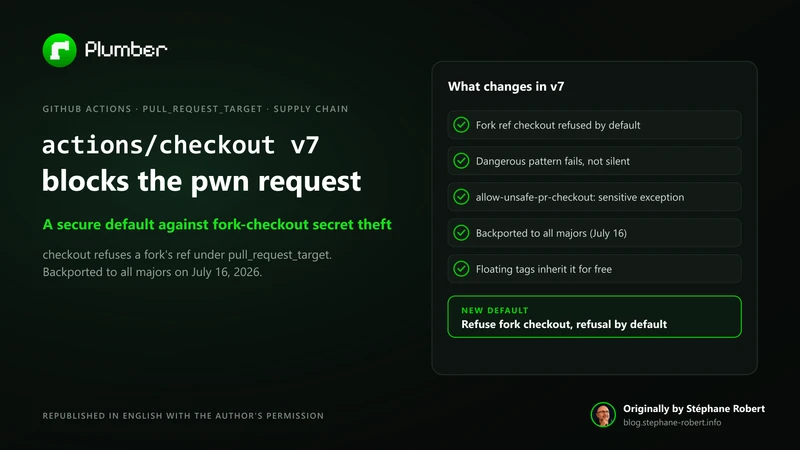
Until now, nothing technically prevented this dangerous checkout: the responsibility rested entirely on the maintainer. With actions/checkout@v7, the default behavior is reversed: when a pull_request_target workflow (or certain workflow_run workflows) tries to fetch a fork’s ref (the PR’s branch or SHA), checkout refuses the operation. The dangerous pattern fails instead of silently pulling untrusted code into a privileged runner.
This is a real shift in philosophy: the guardrail moves from “good luck, be careful” to a refusal by default. The right default, at last.
allow-unsafe-pr-checkout: the exception to watch
Some legitimate workflows need the PR’s code (a linter that comments on the PR, for example). For those cases, checkout v7 adds an input allow-unsafe-pr-checkout that explicitly re-enables the old behavior.
Treat this flag like a production secret
allow-unsafe-pr-checkout: true reopens exactly the door that v7 just closed. It must be justified, isolated in a minimal workflow, and reviewed like a sensitive exception. If you see it show up in a PR with no explanation, that is a red flag, not a configuration detail.
My advice: grep your repositories for allow-unsafe-pr-checkout and require a written justification for every occurrence.
The July 16 backport: why almost every repository is affected
The point many will miss: this is not reserved for those who move to v7. According to Socket’s analysis, the protection is backported on July 16, 2026 to all supported major versions. Since the overwhelming majority of workflows pin checkout to a floating tag (actions/checkout@v4, @v3), they will automatically inherit the new behavior on that date.
Concrete consequence: if one of your pipelines relies today on a fork checkout under pull_request_target (knowingly or not), it may break on July 16. Better to audit it now than discover it in production.
This backport illustrates a pinning trade-off: a floating tag (@v4) gets this change for free (here, a good surprise), but it also exposes you to unwanted changes; pinning by SHA makes you master of the schedule, at the cost of having to adopt checkout v7 yourself to get this protection. Both are defensible, as long as you choose deliberately.
What checkout v7 does not fix
A guardrail is not a pass on rigor. This change reduces one class of attack, it does not secure your workflows for you:
- Template injection (
${{ github.event.issue.title }}inside arun:) remains entirely possible. - Overly broad permissions on the
GITHUB_TOKENremain a problem if you do not reduce them explicitly. - The two-workflow pattern (an unprivileged
pull_requestthat builds, a privilegedworkflow_runthat publishes) remains the right architecture for handling fork PRs cleanly.
All of this is covered in the guide Supply chain attacks on GitHub Actions.
My advice: avoid it when you can
Let me be clear about my opinion: by default, I advise against pull_request_target. The checkout v7 guardrail is good news, but this trigger remains the most dangerous in GitHub Actions, and most needs can be met another way:
- to test or build a fork PR:
pull_request(without secrets) is enough; - for a privileged step (deploy a preview, post a comment): the two-workflow pattern connected by
workflow_run, or an API-only action without checking out the fork’s code.
I reserve it for the rare cases that never run the fork’s code (labeling, commenting via the API), and even then, by genuinely weighing the need. A trigger you do not use is a trigger you do not have to secure.
What I would do quickly
Find the risky workflows
Terminal window grep -r "pull_request_target" .github/workflows/Then check the ones that check out
github.event.pull_request.headand run that code.Fix the root cause, without waiting for v7
Remove the fork checkout, or move to the two-workflow pattern. This is the only real protection, independent of the checkout version.
Anticipate July 16 based on your pinning
- Floating tag (
@v4): the protection arrives on its own, but a pipeline that depended on the dangerous behavior will break that day. Test before. - Pinned by SHA: you will not get it automatically, you will have to move explicitly to checkout v7.
- Floating tag (
Keep
allow-unsafe-pr-checkoutfor the exceptionEnable it only on a justified case, and track its appearance in PR review.
Put detection on autopilot
Plumber (ISSUE-804), zizmor, and poutine catch these dangerous checkouts, so you do not regress.
Key takeaways
- My default instinct: avoid
pull_request_target. The v7 guardrail reduces the risk, it does not make the trigger desirable. actions/checkout@v7refuses by default to check out a fork’s ref underpull_request_target: the pwn request is blocked natively.- The
allow-unsafe-pr-checkoutinput reopens the door: treat it as a sensitive exception, never as a convenience. - Backport on July 16, 2026 to the supported major versions: floating tags (
@v4,@v3) will inherit the protection, and some pipelines will break if they depended on the dangerous behavior. - The guardrail replaces neither minimal permissions, nor the fight against injection, nor the two-workflow pattern.
- It is one more good default: audit now, do not just absorb it later.
Next steps
- Scan your GitHub Actions workflows with the open-source Plumber CLI: unsafe fork checkouts under
pull_request_target(ISSUE-804), dangerous triggers (ISSUE-802), template injection (ISSUE-207), and unpinned actions (ISSUE-701) are detected automatically. - Securing pull_request_target: the safe patterns and the two-workflow architecture.
- GitHub Actions checkout blocks pull_request_target checkouts, Socket: the analysis behind the July 16, 2026 backport.